
Lately, I’ve been remembering back to my mid-twenties (no small task), and an April trip my brother Kevin and I took on the Wisconsin River below the Sauk Dam. It was one of those beautiful spring days, sunny, blue skies, temperatures climbing into the 60s with just a whisper of breeze. We had loaded up my canoe and launched on the west side just below the dam. After a quick row through some fast water, we came to the calm side of the dam. With no water spilling over the dam, conditions were ideal for dropping a jig tipped with a minnow down to the bottom in search of walleye. The spawn bite was usually good, and we were looking forward to bringing home some tasty marble eyes. Little did we know the river had something else planned for us that day.
My brother Kevin was what I would call a “reluctant angler”. He would go fishing with me, but only after much cajoling and promising not to get up at 5 am in the morning. The rest of my brothers were even less fishing inclined. I guess God gave me the lion’s share of the piscatorial genes in our family, something for which I have been forever thankful. Although the rest of my brothers made up for it by getting extra IQ genes, which is why they would never get up at five in the morning to chase two-pound fish.
Lowering our anchor, we settled into the task at hand. We each had standard-issue 6 ½ foot rods of unknown action and backbone, and open-faced spinning reels loaded with 8-pound test monofilament. On the working end of the line, a ¼ ounce jig (green) and a nose-hooked, squirming minnow who somehow knew things were about to go from bad to worse for him. Down 30 feet to the bottom, reel up two cranks, and we settled in for the first telltale tap-tap of a walleye to start our day.
Waiting for our first bite, Kevin, an avid Monty Python fan, started going through his repertoire of Humorous Sketches to pass the time. Noticing my rod starting to bounce, he inquired, “What’s all this then, ay?” as my rod started a deep bow and the tip buried itself underwater. “I’m not sure. I felt a bite, but it feels like it might be snagged on the bottom.” In response to my observation, said snag began moving steadily away from our canoe.
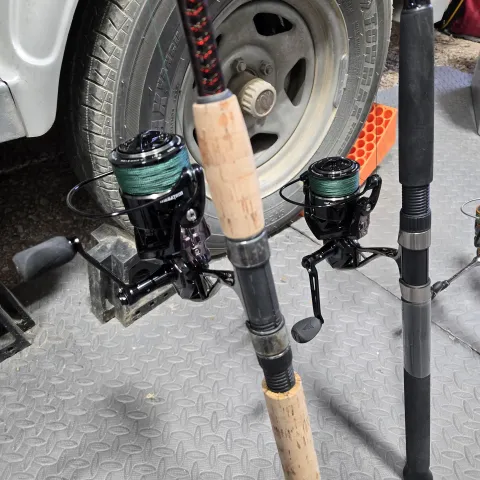
Line started peeling off my reel at an alarming rate. “Bring the anchor up, this isn’t a walleye!”
Looking at my reel, I saw an unsettling sight – the spool was rapidly running out of line. Saying a silent prayer, I tightened down on the drag, and to my amazement, the line did not come snapping back at me. Kevin, always the observant one, noted “The canoe is being pulled by your fish”.
“This is a big fish, I have no idea what I have.” We proceeded to be pulled along by some superior life force, passing other anglers. “You must have a paddlefish,” an old timer called out. Paddlefish… hmm. I told Kevin to Google paddlefish, which, being 1982, made him scratch his head. “What’s a Google”? he said. “Never mind”, my back-to-the-future self replied.
Like my monofilament line, time began to stretch. Kevin ran out of Monte Python material. Slowly, I regained line, pulling and reeling what felt like a big dead weight, except for the occasional short runs. I would like to say this was my finest hour as an angler, as I skillfully fought the fish to our free-floating canoe. But Kevin more accurately said I was the luckiest angler that the line hadn’t broken.
“Hang on, he’s almost to the boat”. With that, Kevin let out a low “damn” as the fish came up as docile as it could be to the side of the canoe. In that moment, I felt the first shudder of fear. The fish was easily a third or more the length of the 17-foot canoe. The jig was attached to the top of the long paddle nose…
GEEK ALERT - The long, paddle-shaped nose of a paddlefish is called a rostrum. This elongated, sensory-filled snout accounts for up to one-third of the fish's total body length and acts as an antenna to detect plankton via electroreceptors.
Neither Kevin nor I had caught anything bigger than a ten-pound carp up to this point in our angling lives. A 6–7-foot paddlefish would weigh 150 or more pounds, and holding on to him at the side of our less-than-stable canoe was a pucker-fest moment for both of us. Kevin reached back and unhooked our Moby Dick, and we watched the fish slowly sink into the depths of the Wisconsin River.
Fast forward twenty-four years. Kevin has been gone for 12 years, but somewhere I have an old story I wrote with his notes in the margins, testifying that there is no exaggeration in the facts that I have shared with you.
Here we are in 2026, and I’m out in Montana. Lo and behold, the State of Montana has a paddlefish recreational season! Not only that, but every year they hold a lottery for catch and keep tags at three locations where anglers can fish for paddlefish: the upper Missouri, the Missouri River under Fort Peck Dam, and the Yellowstone River. The health of the paddlefish population is strong and self-producing, with a thousand tags issued for catch and keep for the Upper Missouri section. Montana’s Fish, Wildlife, and Parks has a well-regulated and managed fishery. It’s incredibly popular, and paddlefish, I’ve read, are very good to eat. Not to mention the eggs make caviar, a delicacy in many places.
Paddlefish are filter feeders that swim at their food with mouths wide open to catch zooplankton in their gill rakers. Because of this, the only way to catch a paddlefish is to snag it. There are snagging seasons in many river systems throughout the United States. To an angling purist, I can easily see how this could be looked at as barbaric and unsportsmanlike. Watching YouTube videos, it looks like a lot of work! Think of paddlefish as the fish of a thousand casts, only you’re casting 6 ounces of lead weight and sweeping your rod with every cast. Be sure to bring your ibuprofen for the end of the day!
After much internal debate, I’ve decided to give it a try this year. I may run out of gas after ten casts, but with any luck I’ll see anglers catch these prehistoric relics – they have a 300–400-million-year-old ancestry, predating dinosaurs. Wish me luck!


