
As summer begins to fade away, excitement is blooming heading into fall with a large coho forecast expected to peak in the weeks ahead.
The front end of the migratory coho run - commonly labeled as silvers by anglers for their bright, chrome-colored body - entered the Strait of Juan de Fuca and Puget Sound in early August, with fair to good catches reported.
Coho (averaging 4 to 15 pounds, with some exceeding 20 pounds) create a lot of fervor, and when hooked, they’ll leap out of the water and make erratic zigzagging patterns across the surface.
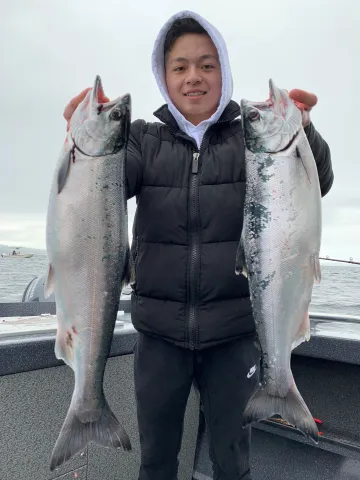
Washington Department of Fish and Wildlife (WDFW) salmon managers indicate that the 2026 coho prediction has the potential to generate the highest statewide recreational fishery catches seen in more than 20 years. Fingers crossed! The 2026 statewide combined hatchery and wild coho forecast is 1,827,748, up from 1,588,658 in 2025. In Puget Sound, the coho forecast is 897,190, up from 727,058 in 2025; 722,134 in 2024; and 760,029 in 2023.
During the North of Falcon salmon season setting process earlier this year, WDFW staff presented the 2026 Puget Sound coho forecasts and abundance trends. For hatchery coho, it showed a 4% improvement, and wild coho are up 53% compared to the 2025 forecast. The recent 10-year average for hatchery coho is up 45%, and wild coho is up 55%. The total Puget Sound coho (hatchery and wild combined) is up 49% from the 10-year average run size and up 22% from the 2025 forecast.
The coho buzz began back in June when Marine Area 10 (Seattle and Bremerton Area) saw good fishing for resident coho. Krill, a major part of a coho diet, has been plentiful in Marine Area 10, as well as baitfish such as herring. The ample feed kept many of the resident fish congregated in the area, and they are now being joined by their larger migratory cousins.
Marine Area 10 is open for coho daily through Sept. 30 with a two salmon daily limit, and anglers must release Chinook and chum. Fishing is also open daily from Oct. 1 through Nov. 15 with a two salmon daily limit, and anglers must release Chinook. Shilshole Bay reopens on Sept. 1. To know when it’s best to hit the water, be sure to monitor the WDFW catch sampling webpage at https://wdfw.wa.gov/fishing/reports/creel/puget.
A good number of coho have already entered the Strait of Juan de Fuca at Marine Area 5 (Sekiu-Pillar Point) and Marine Area 6 (East Strait of Juan de Fuca). These two areas are the barometer of when the peak return of coho will move into Puget Sound.
The Marine Area 5 salmon fishery is open daily through Sept. 24 with a two-salmon daily limit, and anglers must release Chinook, chum, sockeye, and wild coho. Then the area is open daily for all coho retention from Sept. 25 through Oct. 15 with a two-salmon daily limit, and anglers must release Chinook, chum, and sockeye.
In Marine Area 6, the salmon fishery is open daily through Sept. 24 with a two-salmon daily limit, and anglers must release Chinook, chum, sockeye, and wild coho. Then the area is open daily for all coho retention from Sept. 25 through Oct. 15 with a two-salmon daily limit, and anglers must release Chinook, chum, and sockeye.
The best fishing in the Strait tends to be located about one to 10 miles out in the shipping lanes at depths of 200 to 500 feet or deeper. Remember to stay within the U.S. side of the shipping lanes. Look for tide rips and current breaks where krill and baitfish tend to concentrate and attract coho. Also, watch for schools of coho jumping and rolling on the surface.
Moving inland, Marine Area 7 (San Juan Islands) is open daily for all coho retention from Sept. 1 through Sept. 30 with a two-salmon daily limit, and anglers must release Chinook, chum, and sockeye.
Looking for popular inner-sound locations for coho? Try Marine Area 8–1 (Deception Pass, Hope Island, and Skagit Bay), which is open for coho daily through Oct. 11 with a two-salmon daily limit, and anglers must release Chinook and chum. And, just to the south near Everett is Marine Area 8–2 (Port Susan and Port Gardner), which is open for coho daily through Sept. 25 with a two-salmon daily limit, and anglers must release Chinook and chum.
Marine Area 9 (Admiralty Inlet) from Port Townsend south to Apple Cove Point-Edwards Point southernmost boundary line, and all points in between, are open daily through Sept. 18 for hatchery-marked coho with a two-salmon daily limit, and anglers must release Chinook, chum, and wild coho. Fishing is also open for all coho retention from Sept. 19 through Sept. 30 with a two-salmon daily limit, and anglers must release Chinook and chum.
Marine Area 11 (Tacoma and Vashon Island) is open for coho daily through Sept. 30 with a two salmon daily limit, and anglers must release chum and all Chinook (closed for Chinook retention on Aug. 15). Fishing is also open seven days per week from Oct. 1 through Nov. 15 with a two salmon daily limit, and anglers must release Chinook.
Marine Area 13 (South Puget Sound) is open daily for hatchery-marked coho through Sept. 30 with a two-salmon daily limit, and anglers must release chum, wild coho, and wild Chinook. Fishing remains open daily beginning Oct. 1 with a two-salmon daily limit, and anglers must release chum, wild coho, and wild Chinook. Anglers may fish with two poles with a Two-Pole Endorsement. In Marine Area 13, Squaxin Island is a popular area for those targeting hatchery coho.
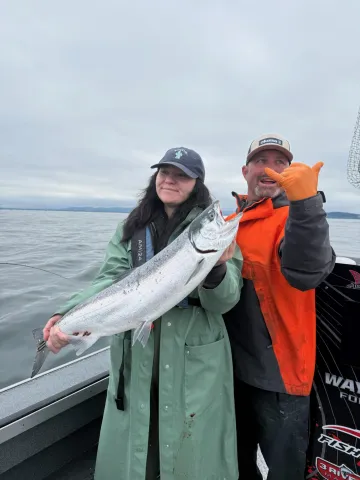
Coho bank fishing access
As these fish turn the corner around Port Townsend and enter Puget Sound, bank anglers can find numerous publicly accessible shorelines and piers that are within easy casting distance of silvers. When accessing these areas, make sure to be courteous and respectful around private property shoreline boundaries.
Top locations in the northern region include Point Wilson in Fort Worden State Park north of Port Townsend; Fort Flagler State Park on Marrowstone Island; Marrowstone Point Lighthouse; and the western and eastern shorelines of Whidbey Island around Fort Casey, Lagoon and Bush points, Bait Box Hole just north of Possession Point, and West and North beaches at Deception Pass State Park. The Oak Harbor Marina also has two net pens where hatchery coho are raised and released annually. In 2022, 30,000 fish were released from the net pen, and fish that survived will return this season to the area.
In northern and central Puget Sound, try Point No Point on Kitsap Peninsula; Browns Bay; Salsbury Point; Edmonds Marina Pier; Mukilteo Lighthouse and the public pier at the Mukilteo Ferry Landing; Richmond Beach and Meadow Point Beach at Golden Gardens; Shilshole Bay Pier; Seacrest Pier in West Seattle; West Point at Discovery Park; Carkeek Park, Lincoln Park and Alki Point Lighthouse in West Seattle.
In southcentral and southern Puget Sound, head to Browns Point Lighthouse Park and Dash Point State Park; Dolphin Point off the east side of Vashon Island; Blake Island State Park; Three Tree Point; Point Robinson Lighthouse, Point Beals, and KVI Beach on Vashon Island; Southworth and Manchester areas; and public piers at Des Moines, Redondo, Les Davis, and Point Defiance Park Boathouse.
Stay clear of large ships in shipping lanes
Many coho tend to congregate in the shipping lanes, and fishing is legal in the ship traffic lanes as long as the lanes are kept clear for ships, according to the Board of Pilotage Commissioners of Washington.
Shipping lanes should be cleared when ships - who have the right of way - are five minutes away (about two miles) to avoid impeding traffic. Be aware of your surroundings and monitor vessel traffic on VHF radio channel 14. Lastly, anglers should stay out of ferry lanes when ferry boats are present.
The U.S. Inland Navigation Rules and COLREGS Rule 10 state: Vessels less than 65 feet in length shall not impede the passage of vessels transiting the traffic lanes. For more information, refer to the Board of Pilotage website at www.pilotage.wa.gov.
Westport Boat Basin coho fishing
On Washington’s central coast, the Westport Boat Basin coho-only fishery is open daily through Jan. 31, 2027. The best timing is September through October as coho raised in the marina’s hatchery net pens begin to return.
The daily limit is six salmon, and no more than four may be adult fish. Anglers must release Chinook. No night fishing and an anti-snagging rule is in effect, and any hooks where the weight is molded directly to the hook - such as twitching jigs, swim jigs, or casting jigs - are not allowed. Only single-point barbless hooks may be used. The Catch Record Card (CRC) code for the basin fishery is 2-2W.
(Mark Yuasa is a Washington Department of Fish and Wildlife Communications Manager and longtime local fishing and outdoor writer.)


