
Known for hiding the shipwrecks of the Graveyard of the Pacific, the sands near the mouth of the Columbia also hold a secret lair of North America’s largest freshwater fish. White Sturgeon in the Columbia River Estuary regularly reach enormous sizes. These secretive giants provide a fight that compares with billfish, both in ferocity and acrobatics.
Just after Father’s Day, I invited my friend Jamie to join my son and me for a scouting trip. I wanted to add some more spots to my list of options for my clients the next day. I was looking for deeper channels running next to broad shoals. Ideally, I would find a submerged cove.
I anchored the boat up-current from a group of fish that I had spotted using my side-scan sonar and hung drift socks to keep the boat as steady as possible. Sturgeon are shy biters, and any movement of the bait before they commit can throw them off. I also use extra-long leaders, at least 3 feet, to give a little extra wiggle room. The current helps carry the bait scent towards the fish and draws them into our gear. The bite will often slow or completely stop during slack tide.
Like all fish, sturgeon follow their food. Upriver, that means deep pools. In the estuary, the sand flats grow a carpet of small creatures, including shrimp, worms, mussels, and clams. The sturgeon wait for the incoming tide and cruise up onto the flats for this buffet. Sometimes we’ll spot them feeding in as little as a foot of water with their backs and the tops of their tails visible. When the tide moves out, they shift into the deeper channels and ditches.
I tied on a 3-foot Dacron leader in 120-pound test. In addition to strength, the Dacron provides abrasion resistance. Sturgeons have sharp plates along their sides and spines. A hooked sturgeon will use an alligator-style death roll to wrap the line around itself and cut the line. Despite their strong sense of smell, their eyesight is poor. Where other species might ignore something with a thick visible line, the sturgeon don’t seem to notice it.
I had pre-baited several leaders that morning with live sand shrimp. The local bait shops stock them, but you generally need to order ahead of time to guarantee that you’ll have them. Once in the estuary, the sturgeon prefer shrimp, even over traditional favorites like smelt and squid. I half-hitch two shrimp onto each leader, with the bottom one also being caught in the hook’s bait loop. I know some folks who use bait threading needles, and I do prefer that method for durability when I have a needle available.
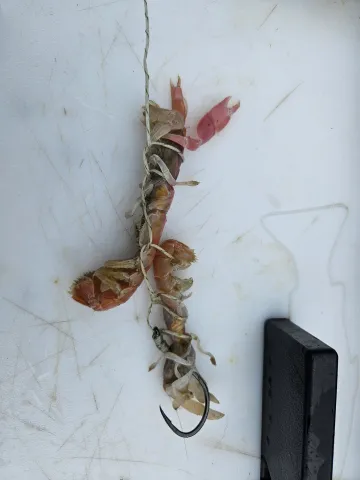
For the hooks, I use Gamakatsu Big River Bait Hooks in a 6/0 size. We are required to pinch the barbs and are only allowed to use one hook. The hard-angle bend at the bottom of the hook does a better job of staying in if the line goes slack. While I grumble about barbless hooks for salmon, with sturgeon I wouldn’t want to have to get one out of their mouth anyway. Their tough skin would require a lot of work to extract one.
For a quick swap after a missed swing, the tops of my leaders are tied into a surgeon’s loop. I slide the loop into a McMahon-style snap hanging from a bead chain swivel. These snaps are strong, generally don’t tangle with my leader, and are fast to swap out once you get used to them. My main line is a 60 lb braid with a heavy swivel sandwiched between two beads ahead. Hanging from the sliding swivel is my lead. I usually use 6 oz pyramid-style weights to help hold the gear out in a wide spread in the current. In heavy current I’ll run up to 10 oz, but that’s rare.
After I attached the leader, I looked around for a spot. I generally try to cover as many different areas of water as possible, and the spot I chose had a good mix of super shallow flats alongside a 15-foot-deep channel. My plan was to spread the gear out and see where the fish were concentrating at that moment. Whenever possible, I always like to hedge my bets.
I swung the rod carefully while thumbing the reel to prevent backlash. I typically use a casting-type reel. I caught my first sturgeon on a spinning reel, and it’s not a bad choice, though. The casting reels just take up less space in the boat. Getting used to them also means I can change plans on the fly if the Spring Chinook bite is slow. The lead and bait landed in the shallows about 100 feet away. Based on the timing between when the lead hit the water and when I felt it hit the bottom, I’d say I was in about 2 feet.
I use the same mix of Lamiglas Battle Glass and Daiwa Beef Stick rods for bottom fish, and it also saves me from having to buy a whole additional setup. Sturgeon don’t care how much you paid for the rod. They just need something strong. To catch them, you just need a tip soft enough to detect a bite and a backbone strong enough to set the hook through their catcher’s mitt of a mouth. The rod also needs to not snap when a 500 lb fish decides it wants to start peeling 200 feet of line off your reel!
A few of my rods, especially the softer Lamiglas rods, show signs of being repaired from when the tips came up against the boat while fighting a particularly devious fish. I have used my heavy salmon trolling rods, but the ones that have found use as sturgeon rods have become sources of spare parts after a few trips.
Usually, when a sturgeon bites, the tip of the rod will twitch slightly. The hardest part of sturgeon fishing is lifting the rod out of the holder without tipping off the fish. I told Jamie, “When you feel it pull, set the hook as hard as possible.” A few minutes later, the rod tip twitched - first softly, then harder. Jamie grabbed the rod, pressed his thumb against the spool like I taught him, and pulled back. The rod stopped in mid-swing and then pulled down hard. Fishing rods make a distinct angle when hooked with a big fish - the backbone of the rod usually goes straight up from the angler’s hands. The mid-range forms a perfect 90-degree curve over about 12-14 inches, while the softer top section will end up pointing directly at the fish. For those who live in more metropolitan areas, the feel in your hands is about the same as hooking into a city bus.
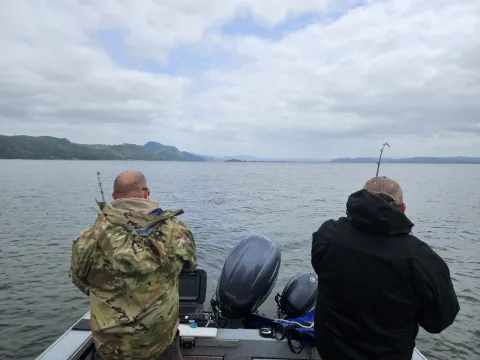
Bobby and I scrambled to pull in the other gear while Jamie held on for dear life. The reel’s drag was probably close to combustion, and the fish had only been on for a few seconds. I looked up just in time to see a massive prehistoric beast jump fully into the air behind the boat. When you have to look up to see your fish, you know it’s big. This sturgeon had decided to remind us that it comes from a time when dinosaurs caused the earth to shake. Over eight feet and nearly 300 pounds of angry, armor-plated fish hit the water and began making a big run. Before we could throw the anchor buoy overboard, the line counter was already at 400 feet.
I used the motor to follow the fish and ease the load on Jamie. The tradeoff in this strategy is that the fish doesn’t get tired as quickly. Once we had gotten back to less than 200 feet of line, I restricted myself to just keeping the boat angled so that the fish wasn’t underneath us or on the opposite side. I wanted to use the boat to help tire out the fish.
Jamie is an experienced fisherman. He’s fought plenty of large salmon in his time and knows that when the fish is running, you keep the tip up a bit so that the rod does the work. He was perfect at waiting for the fish to start to turn before reeling so that he didn’t tire himself out. Despite this, I could tell that the long fight was wearing him out.
Over the next 70 minutes, Jamie brought it to the boat three times - each time the fish would blow bubbles and roll onto its back. This is usually a sign that the fight is about over, but this one did this each time and was not done. Every time I tried to grab the base of its tail so that we could hold it still for pictures, it would wake up and take another run.
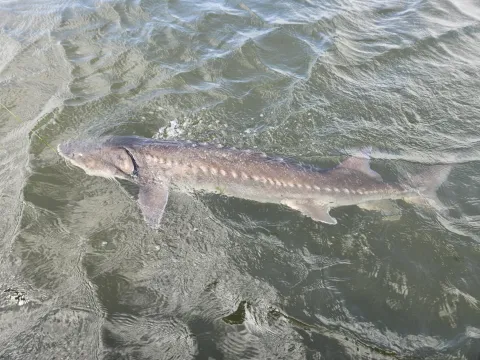
After drifting for approximately 2 miles, we made one last attempt to get the fish to the boat for a picture. This time, instead of taking off and away from the boat, it ran underneath. The mainline rubbed against the boat chine, found a nick, and the beast was gone. We were exhausted. Jamie’s arms were rubber, and we all agreed it was time to head home. Somewhere - maybe still in the shoals of the Columbia - that sturgeon is out there, growing even larger.


