
I recently had the chance to fish for hatchery winter steelhead in a small tributary stream leading up to and past a state hatchery. This is not a secret spot, but I will not mention the name of this specific location. What I found was that the techniques and practices that I use on larger rivers were no good at this place, and I needed to refine my approach. This took me back at least 30 years to a time when I fished for trout in small mountain streams with spinners and bait rigs.
To start, let's discuss the differences between creeks, streams, and rivers. Rivers, streams, and creeks are all natural, flowing, ribbon-like bodies of water constrained by banks and a bed, with the primary differences being size, flow volume, and their role in the watershed hierarchy. Rivers are generally the largest, acting as main channels, while creeks are smaller, often shallower, and frequently serve as tributaries to larger streams and rivers.
Some key differences include:
Size and Volume: Rivers are larger, deeper, and wide enough for some navigation, whereas creeks are small, narrow, and shallow (sometimes 5-15 feet wide). Streams fit in between, typically 15-30 feet wide.
Hierarchy/Tributaries: Creeks are usually small watercourses that feed into streams, which then feed into larger rivers.
Permanence: Rivers are typically perennial (flow year-round), while smaller creeks might be intermittent or seasonal, sometimes drying up.
Flow Velocity: Creeks are often faster, shallower, and may have more turbulent, steep paths, while rivers have higher volume and move more slowly in wider, flatter channels.
Naming Conventions: Often, the distinction is based on local, regional, or historical terminology rather than strict, universal scientific definitions.
When we think of a stream, we often picture fast-moving water that flows downhill on a typically steeper descent than a river. They are generally full of rocks and gravel, have steep banks and cutouts, and sometimes flow through gulleys or canyons. The water is generally shallow throughout, containing pockets of water behind large rocks, against cutout banks, and in the slower, flatter sections of the stream.
For those of us accustomed to drift fishing, bobber dogging, and floating jigs, worms, and bait - we are a bit out of our element in this environment. Everything must be downsized and simplified as we have very limited water to work with, and the stream topography is very grabby, resulting in lots of snags and lost gear.
For my winter steelhead trip, I came prepared with small stick weights, Dave’s Tangle Free weights, and two shot slinkies to get my gear down. For the terminal end of my gear, I used a single #2 hook with an egg loop and a small piece of yarn. Despite this downsized presentation, my weights were still getting caught in the rocks and I was forced to wade to retrieve my gear or just break it off and start fresh.
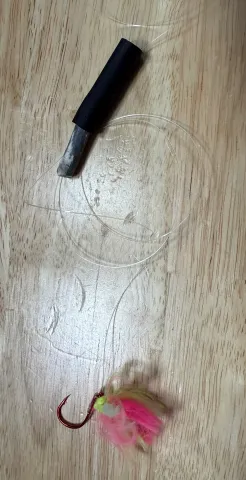
I noticed that other anglers who have been fishing this location for years were employing a different technique, one that I had not seen before. To avoid getting caught in the rocks, they slid a piece of ¼” ID surgical tubing over their mainline and inserted a piece of solid core pencil lead in varying lengths, based on the depth of the water they were fishing and the flow rate. They also employed a single hook with either a cheater/corky or a piece of yarn above the hook. To adjust the leader length, all you have to do is slide the tube up or down the mainline, moving your presentation closer or further from the lead. What I found is that this method of applying weight to the rig was not only simple, but practically eliminated the snags as the gear flowed over the rocks and other snaggy stuff in the stream. When they did get snagged, the lead would pull out, and the fishermen would get their gear back. I know that we want to avoid depositing lead in our streams and rivers as much as possible - and I can attest that during the day that I fished, I only saw one angler lose his piece of lead. This is quite incidental, and the method is very effective in reducing the amount of gear deposited into the stream.
In the deeper pools, more traditional methods may be used, but the weighting system can remain the same. Since the pieces of water are small, the gear must get down quickly to have a chance at holding fish. In the deeper water - beads, bait where allowed, small worms, and other presentations can work. Small spinners can also produce fish when there is enough water.
Keep a couple of things in mind: First, there is very limited space to cast, so you’re really tossing, flipping, or lobbing your gear to the top of a drift. Casting will generally put you in the wood on the other side of the stream. Second, since the water is generally shallow and often very clear, you can sight fish, but keep in mind that if you can see them, the fish can probably see you. It is best to be very stealthy and, when possible, try to get above the fish and let them settle down for a few minutes before you target them. Once they see you, they will be unlikely to strike your presentation until the threat is gone and they feel comfortable again.
One more thing to consider: If you are fishing the lower section of a stream, near the mouth, plan for several techniques. You can often walk the stretch of stream that you are considering fishing to see if there are any fish holding. If you don’t see any conditions, suggest that the fish would move back downstream for cover. The mouth of the stream, where it joins with the river, can be a great place to find fish. Fish will always seek cover, whether it be shade, wood, behind rocks, or in deep pools. At times, they will seek cover in faster-moving water that is broken or riffled on top, offering a layer of protection. When they cannot find these things, they will turn around and head back downstream. Generally, at the confluence, there will be some deeper water, and the fish may stage and hold there until they feel inclined to head upstream again. I love to fish these areas with beads and worms, either under a float or along the bottom. Jigs and worms can be options as well, jigs being one of my favorite techniques to employ in lower, clearer water conditions. Bring out the bigger worms, even in brighter colors, when the water is high or has good color.
As anglers, I think that we all like to be challenged. Streams will challenge you and force you into a different approach. I found it very satisfying and a reminder of my childhood years chasing trout in streams. Give it a shot and have fun.


