
Buckle up, Northwest Fishing readers. You’re about to get a blend of the best of both worlds - a history lesson on this great country and one of its key transformative features that allowed for expansion, as well as a little bit of fishing knowledge for consideration when planning future trips. I’m a history buff, enjoy a little bit of windshield time, and of course, an avid fisherman. I’m sure there are quite a few of you out there that share a similar enjoyment as I do, and if you don’t, that’s fine too. I am almost certain you are here for the fishing information anyway! To those in the latter camp, continue to indulge me a little bit as we talk about one of the key interstate systems that connects the West Coast to the East Coast, spanning from Seattle, Washington, to Boston, Massachusetts. Being a Montanan, I’m going to give you a few stops along the way in this great state for you to think about as you make the nearly 3,100-mile trip along Interstate 90.
As noted, Interstate 90 (I-90) is just under 3,100 miles and is the longest highway in the U.S. Interstate System. Established under the Federal-Aid Highway Act of 1956, it was officially numbered in 1957 as the northernmost transcontinental route. My personal favorite president, Eisenhower, felt it was a necessary transportation need for the country that would strengthen the US defense and economic output after his experience with the autobahn during World War II. Its creation replaced earlier U.S. Highways and auto trails, unifying them into a modern, high-speed corridor designed for safer, more efficient long-distance travel. The project spanned over decades, with most of the remaining western segments between Seattle and South Dakota opened by 1987, completing the continuous coast-to-coast route.
As much as we may wish fishing access was the intent of the creation of the interstate, it was not. We, as anglers, however, gained convenient access to many tremendous waterways along the route. Let’s dig into those easily accessible bodies of water here in Big Sky Country, just a short jaunt off I-90, in no particular order.
1) Yellowstone River - Many of you are familiar with a little place called Yellowstone National Park, I’m sure. The Yellowstone River, as you’d expect, flows through the park while heading northeast throughout the state. It weaves along I-90 in several areas starting in Livingston and through the northeast corner of the state, but unless you're an angler looking for a remote fishing experience (and maybe you are!), its I-90 journey ends in Billings. To those wanting to make the drive along I-90, these cities offer anglers amenities you’d expect when planning a fishing trip, while also being able to quickly get into big fish. Anglers can expect to find rainbows and brown trout, as well as cutthroat and mountain whitefish.
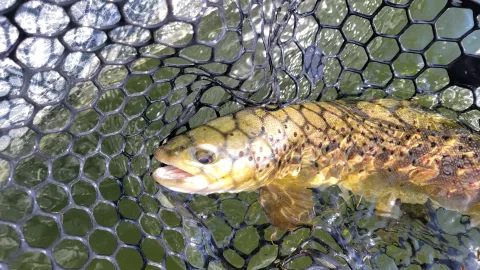
2) Clark Fork River - Sticking with accessible river fishing, Clark Fork is more than worthy of consideration if you plan to make a drive along the interstate. Many folks will talk about fishing in Montana on the Yellowstone River, and of course, the Missouri, but this river is as worthy of a day or two of fishing as any in the state, and certainly along the interstate. Perhaps because of the infamy of the other rivers, the Clark Fork can often be less crowded than other fly-fishing rivers in the state. Anglers can expect to catch similar species of trout, but may also find westslope cutthroat along with the native Mountain Whitefish that lurk in the river. Speaking of lurking, depending on how adventurous you want to be, you may even get into some pike if you’re looking to target something else while on the water.
3) Canyon Ferry Lake - Northwest Fishing fans may remember a combination pizza/walleye episode filmed on the lake, and while the lake doesn’t have the size of fish that some anglers may crave, it does offer plentiful limits and a variety of species to be caught. Its location, just a short drive off the interstate, gives it both convenience and aesthetics as it is tucked in the Rocky Mountains with the Big Belt Mountain Range looming over it. If for nothing else, the views surrounding the lake are worth it on their own, and the fishing is just an added bonus! It is a must-stop location with its scenic views, close but slightly out-of-the-way access, and an abundance of different fish to catch make it a worthwhile stop on your travels.
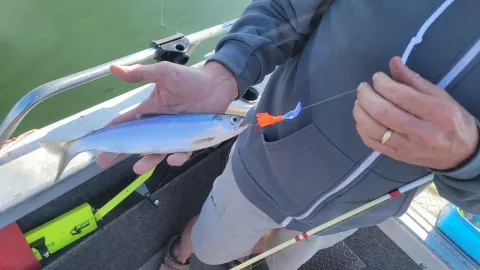
4) Georgetown Lake - Georgetown Lake is an ice fisherman’s paradise nestled in the western part of the state, sitting at nearly 6,500 feet. Kokanee are the prize here, and many consider Georgetown to be the destination for those looking to limit out. Like many kokanee, anglers can expect to catch fish in the 8-10 inch range, with some getting up to 15 inches. The limit on these kokanee? Not 10 daily, 15 or even 20. There is no daily or possession limit for the fish on the lake. To those looking to create a little kokanee candy, fire up the smoker and plan to spend some time at Georgetown and catch fish until eternity - or at least whenever the state decides to change the regulations.
5) Missouri Headwaters - We’ll end with a trifecta, actually, rather than one fishing spot. The Missouri Headwaters near Three Forks provides anglers with an opportunity to fish three distinct Montana rivers in one central location. The Jefferson, Madison, and Gallatin Rivers all meet along the south-central side of the state, just minutes off the interstate. While some of the better fishing would be had elsewhere along any of those three rivers, the significance of the Missouri Headwaters cannot be overstated, as it was a pivotal point in the Lewis and Clark Expedition, is the starting point for the Missouri River, and also provides anglers with access to premium trout fishing anywhere in the country. The benefit of being situated just off of I-90 and close to a major city like Bozeman only adds to the allure of this historic and fishy spot.


