
When it comes to spot shrimp fishing, May and June are a “shrimp-tacular” time to be on the water in Puget Sound, Hood Canal, San Juan Islands, and Strait of Juan de Fuca.
The recreational spot shrimp fishery will open on May 24 in many Puget Sound marine areas, with additional dates scheduled in several areas into early July. The one area to have an opening prior to May 24 will be Marine Area 12 (Hood Canal), which will have an early opportunity on May 10.
“Test fishery data in Marine Areas 9 (Admiralty Inlet), 10 (Seattle-Bremerton Area), and 13 (South Puget Sound) continue to indicate low abundance of spot shrimp,” said Don Velasquez, a Washington Department of Fish and Wildlife (WDFW) Puget Sound shellfish biologist. “As a result, these areas are not scheduled to open for recreational spot shrimp harvests in 2026 (similar to the closures in 2025).”
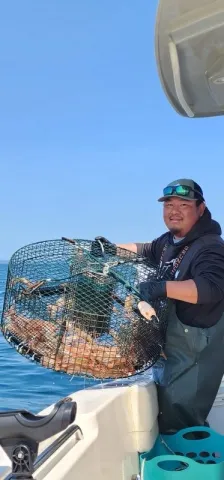
WDFW fishery managers selected the shrimp fishing dates to offer opportunities to harvest spot shrimp while distributing participants and reducing the chance of exceeding recreational harvest quotas. Due to high expected turnout, some areas cannot support weekend openings while remaining within their current quota.
To ensure a safe and enjoyable experience, shrimpers are encouraged to monitor weather conditions and avoid launching or leaving the dock if their vessel can’t safely participate. Check with local access ramps and marinas ahead of time to stay informed on potential closures or fee changes. Allow extra time for launching boats, show courtesy to others at the boat ramps, and respect others’ gear while on the water.
Spot shrimping is one of Washington’s signature recreational fisheries that occurs during the spring for these tasty prawn-sized denizens of the deep.
In all open areas of Puget Sound, the daily limit per shrimper is 80 spot shrimp with a total daily weight limit of 10 pounds (whole shrimp) for all species of shrimp combined. Shrimpers who retain only spot shrimp may remove and discard the heads while in the field and before returning to shore. Shrimpers retaining any shrimp species other than spot shrimp must continue to retain the heads until finished and on shore to verify compliance with the 10-pound daily limit.
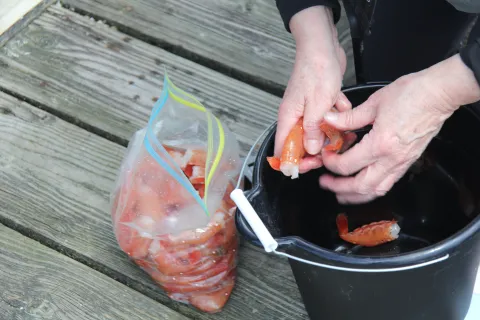
To avoid going over the daily limit, count your catch not once but twice or three times and put each limit into separate containers. Nothing is worse than being checked and finding out you’re one spot shrimp over the daily limit. Also, keep in mind that each angler can have only two traps and a maximum of four traps per boat, meaning when you are near the point where you only have one last limit to catch, you cannot have four traps sitting in the water.
More information on recreational shrimp fishing rules, seasons, and marine areas is available on WDFW’s webpage, including a webpage on shellfishing gear rules at https://wdfw.wa.gov/fishing/shellfishing-regulations/gear-rules.
Shrimpers are reminded that traps can be set one hour before official sunrise during any open period in the marine areas without specified harvest hours. These include Marine Areas 4, 5, 6 (except for the Discovery Bay Shrimp District), Marine Area 7 East, Marine Area 7 South, and Marine Area 7 West. The pots must be removed from the water in these same areas by one hour after sunset at the end of an open period. The start and end times for all other areas are listed above.
Seasons for non-spot shrimping (dock, coonstripe, sidestripe, and pink shrimp only) will begin later this year and will be announced separately. During non-spot shrimp seasons, 1/2-inch mesh pots are allowed, depth restrictions are in place, and all spot shrimp are required to be released immediately.
A rule adopted in 2025 prohibits setting shrimp gear from a vessel near 19 designated Washington State Department of Transportation-managed ferry terminals in Puget Sound and the San Juan Islands (Marine Areas 7, 8-1, 8-2, 9, 10, and 11).
Shrimpers and other boaters are reminded to follow Washington rules to help protect endangered Southern Resident killer whales (SRKWs). Under state law, recreational vessels in Washington waters must stay 1,000 yards away from Southern Resident killer whales (SRKW). For details about steps boaters and fishers can take to keep the whales – and themselves – safe, refer to the Be Whale Wise website at https://www.bewhalewise.org/.
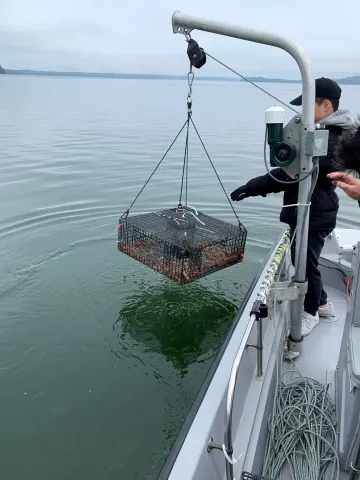
Tips to catch spot shrimp
Top of the list when planning a spot shrimp fishing outing is to make sure all your gear – pots rigged correctly, yellow buoys, line, cooler and ice, electric pot puller, and boat motor – is ready to go, and the bait is properly prepped before you leave home.
Another key point to keep in mind is that this highly popular fishery draws hundreds of anglers, so allow yourself plenty of time to get to the boat launch and secure a parking space, which can be limited depending on the area.
One of the tips that can make or break success is knowing where the schools of spot shrimp are congregating. The majority of spot shrimp can be found in deeper depths along steep ledges, drop-offs, and sharp inclined bottoms, and usually lurking in 200 to 350 feet of water.
Once you’ve located them on the fish-finder, make sure to scatter your pots across a broad area and set them at various depths because schools of spot shrimp tend to move around quickly depending on the tides and currents.
The amount of weight to keep your pots on the bottom depends on the tide, current, waves, and wind. A safe bet is anywhere from 20 to 30 pounds, and be sure they’re evenly placed and secured around the corners of the pot. Allow a one to two-hour soak before the first pull. This provides you with at least two more chances during a brief four-hour fishing period.
The bait mixture is another important factor in catching spot shrimp, and prep a good slurry of bait ingredients and thickness similar to yogurt. Make sure the scent cloud is leeching out of the trap consistently.
For the bait itself, use a good amount of shrimp bait pellets mixed in with oily tuna, whitefish, or salmon in a five-gallon bucket. Bring a large ladle or scooper and latex gloves, as it can get rather messy, and nothing is worse than a bunch of stinky slime on the boat deck. Be sure to add several cans of cat food with small holes punched into them just before you drop the traps. Don’t forget to take around 25 to 35 extra cans of cat food; more is better than running out while out on the water with a grocery store nearby.
A medium-sized square pot with a bait barrel (bring extra bait barrels) connected to a four-way rope harness attached to each corner of the pot. Keep your bait barrel securely fastened to the trap with a wide strip of elastic cord. Using a biodegradable escape cord made of cotton (or other natural fiber) will degrade and reduce the amount of shrimp wasted if the pot is lost and required on all shellfish traps.
Having an electric pot puller is a wise investment, especially when pulling up a 35-plus-pound trap from 300 feet of water. The Scotty Electric Pot Puller and the Ace Line Hauler Pro are two ideal choices that can be placed onto a Scotty downrigger mount and plug.
For buoys, go with a large round (soccer ball size) yellow buoy (your full name and address is required on the buoy and must be legible) attached to a secondary buoy stick with a flag or staff. A phone number is highly recommended. Use a colorful flag or staff to help easily locate your own buoy among the thousands of other buoys set nearby. Always attach buoys with the rounded end towards the trap and not the flat end, which creates more drag and can snag floating debris. Never use empty containers (like a one-gallon milk container) as a buoy, and it is illegal since they create drag and fill up with water and sink.
For each pot, use at least 400 feet of sinking lead line. The line length is dependent on how deep you drop the pots. Tide changes will alter your water depth, so a good tip is to use a line that is 1/3 longer than the maximum water depth to prevent losing a trap. Avoid using lines with a large diameter, particularly those greater than 5/16 inch, which create more drag in a current and can pull lighter traps away from where they’re set. You can also add a weight to the line. Propellers can sever floating lines on the surface and will increase the chance of entanglement with floating debris. Before heading out, make sure the drop lines are coiled neatly and ready to deploy.
Spot shrimp are high in Omega-3 fatty acids with a nice, sweet flavor to the firm meat texture. They can be eaten raw, and if cooked, boil them for one to two minutes at most or until they turn pink. If possible, live spot prawns should be prepared the same day they’re caught to avoid them becoming mushy.
To keep spot shrimp in the best condition, ice immediately after you catch them. Shrimp can be kept in the refrigerator for a couple of days to be eaten fresh. Freeze immediately if you plan on saving them. Never store them with tap water, as chlorine kills them. If kept overnight, remove the heads as the digestive enzyme makes the flesh turn mushy.
Lastly, now that spring has arrived, you’ll need a 2026-2027 recreational fishing license valid from April 1, 2026, through March 31, 2027. WDFW offers two mobile apps https://wdfw.wa.gov/about/apps, and both apps are designed to make your outdoor experience easier and more efficient. MyWDFW serves both hunters and anglers, offering electronic tagging, harvest reporting, and access to licenses and permits, and go to https://wdfw.wa.gov/about/apps/mywdfw for details. The Fish Washington® at https://wdfw.wa.gov/fishing/regulations/app is tailored for anglers, providing fishing regulations, digital catch cards, and license management. Licenses may be purchased online at https://fishhunt.dfw.wa.gov/login or from hundreds of license dealers across the state.
(Mark Yuasa is a Washington Department of Fish and Wildlife Communications Manager and longtime local fishing and outdoor writer.)
Before making plans to go spot shrimp fishing, anglers should check the WDFW emergency rules webpage for possible in-season closures. at https://wdfw.wa.gov/fishing/regulations/emergency-rules.
Here are the 2026 spot shrimp fishing dates:
● Marine Area 4 east of the Bonilla-Tatoosh Line: Open daily beginning May 24. Shrimping is allowed during daylight hours only. The recreational spot shrimp season closes when the quota is met or Sept. 15, whichever comes first.
● Marine Area 5 (western Strait of Juan de Fuca): Open daily beginning May 24. Shrimping is allowed during daylight hours only. The recreational spot shrimp season closes when the quota is met or Sept. 15, whichever comes first.
● Marine Area 6 (Port Angeles Harbor, eastern Strait of Juan de Fuca, excluding the Discovery Bay Shrimp District): Open on May 24, May 26, June 7-8, and June 21-22. Shrimping is allowed during daylight hours only. An announcement regarding additional dates may be made later in the season.
● Marine Area 6 (Discovery Bay Shrimp District): Open on May 24 from 9 a.m. to 3 p.m. only. An announcement regarding additional dates may be made later in the season.
● Marine Area 7 East (northern Rosario Strait, Bellingham Bay, Sucia, and Matia islands, Strait of Georgia): Open on May 24, May 26, and June 7-8. Shrimping is allowed during daylight hours only. An announcement regarding additional dates may be made later in the season.
● Marine Area 7 South (Iceberg Point, Point Colville, Biz Point, Salmon Bank): Open on May 24, May 26, and June 7-8. Shrimping is allowed during daylight hours only. An announcement regarding additional dates may be made later in the season.
● Marine Area 7 West (San Juan Channel, Speiden Channel, Stuart, and Waldron islands): Open on May 24, May 26, June 7-8, June 21-22, and July 18-20. Shrimping is allowed during daylight hours only. An announcement regarding additional dates may be made later in the season.
● Marine Area 8-1 (Saratoga Passage, Deception Pass) and Marine Area 8-2 (Port Susan, Port Gardner, Everett): Open on June 8 and June 22 only with shrimp fishing allowed from 9 a.m. to 1 p.m. each day. An announcement regarding additional dates may be made later in the season.
● Marine Area 9 (Edmonds, Port Townsend Bay, Admiralty Inlet): Closed for spot shrimp harvest in 2026 due to low abundance.
● Marine Area 10 (inside of Elliott Bay east of a line from West Point to Alki Point): Closed for spot shrimp harvest in 2026 due to low abundance.
● Marine Area 10 (outside of Elliott Bay west of a line from West Point to Alki Point, which includes the Bainbridge Island shrimp fishing grounds): Closed for spot shrimp harvest in 2026 due to low abundance.
● Marine Area 11 (Tacoma-Vashon Island): Closed for spot shrimp harvest until further notice. An announcement regarding an opening may be made later in the season if sufficient quota is available.
● Marine Area 12 (Hood Canal Shrimp District): Open on May 10, May 24, May 26, June 7, and June 21 from 9 a.m. to 1 p.m. only. An announcement regarding additional dates may be made later in the season.
● Marine Area 13 (South Puget Sound, Carr Inlet): Closed for spot shrimp harvest in 2026 due to low abundance.


