
Back in July of 2017, while driving up the Olympic coast on a surf trip, I stumbled upon a beach campground just south of La Push, Washington. A large northwest swell pushed in sets of violent waves that towered up to around 10 ft in height. The waves lacked the shape required for any attempt at surfing, yet the campground was beautiful and provided excellent views of the Pacific Ocean. Impressed by the campground, we decided to settle down there for a day of camping. The atmosphere around the camp was strangely quiet and somber, and as we were about to learn, it was for good reason. A man approached us and began to inform us of a tragedy that had happened just hours earlier that day. Apparently, a fisherwoman who was surf perch fishing with her family that morning had been knocked off balance by an incoming wave. Despite the efforts of the anglers around her and the rescuers who appeared soon after the incident, the woman succumbed to the power of the sea that day.
Fishing in general can be a dangerous pursuit. Whether it’s crossing the infamously deadly Columbia bar in search of salmon in the Pacific Ocean, encountering inclement weather on your kayak during a spring lingcod trip, or treading about on a thinning sheet of ice during late season ice fishing. With all fun outdoor adventures comes risk. This is not to say that risks should keep us from going outside, yet risks should be something that we evaluate with great attention.
Winter is a perfect time of the year to practice your risk assessment skills; this is especially true on the coast when the weather and seas can become violent. Winter is surf perch fishing season for me. Salmon season is for the most part over, the perch are out of their spawning period, they’re fat, and they’re plentiful. Furthermore, with the winter razor clam season well underway, it’s quite feasible to combine a razor clam trip with a surf perch trip if that’s your thing. But wintertime is when the seas are at their highest, so how do we stay safe while fishing off the beach or while wading in the surf?
Tide, Swell, and Beach Terrain
Before going out, it is crucial to understand what is happening with the ocean. Resources like the NOAA website are a great place to figure out important information like tides, swell height, and weather. Winter is the season of King tides, so it is imperative to make sure the tide level isn’t going to be at an extreme high for your trip. Average swell height for the Washington coast during the winter ranges from 6-10 feet, but it often will get even higher. A good practice is to avoid the beach if both the tide height and the swell height are forecasted to be higher than average.
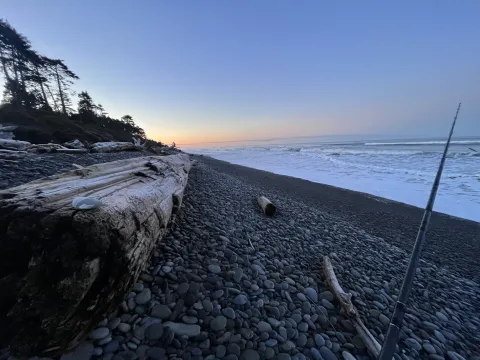
Not all beaches should be treated equally. The most productive spot I’ve ever fished, the north coast of the Olympic Peninsula, the same spot where the unfortunate tragedy previously mentioned happened years ago, can be a particularly dangerous spot due to the beach terrain. Most of the beach in this spot is steep. Being that I fish at high tide (the best time for surf perch), I choose to spend the entirety of the high tide atop the slope, out of the water. Venturing down the slope and wading into the water essentially pins you between the ocean and a steep hill behind you, leaving little to no room for escape.
If conditions are a bit too extreme for this spot, I only have to travel about 5 miles south, where there’s access to several miles of flat beach. Flat beaches are significantly safer for surf perch fishing and should be favored during sketchy conditions. At flatter beaches, the waves typically break further offshore and have a much wider swash zone (the portion of white water in front of the waves nearer to the beach). With a wider swash zone, you have more time to retreat back if needed while wading in the water. These areas can be very productive as well if you have scouted at low tide and successfully found depressions on the beach where surf perch like to school up and feed.
Skip the dip
Many people think it’s a requirement to wade waist-deep into the water when chasing surf perch. There are many spots, especially those where the waves break close to shore, where you gain little more than 10 yards or so by getting wet. Most of your surf perch fishing can be had without ever touching the water. To compensate for the distance to the fish you might lose by staying dry on the beach, simply add more weight to your rig so you can cast further out. In many cases, during a high tide, the fish will congregate very close to shore, and a far cast isn’t even necessary. The point is, becoming overzealous with wading out is what can easily get you in trouble in the water. It doesn’t take much for a wave to catch you off guard, and suddenly you're in over your waders. If possible, skip the dip and stay on shore when conditions are at all questionable.
Rolling Logs
By all means necessary, stay far away from beach logs that are anywhere near the path of the incoming tide. Logs are very buoyant, and it only takes a small amount of water to lift a log that may be well over a thousand pounds. Logs that become adrift are responsible for many accidents and deaths amongst beachgoers who are unaware of the dangers. As shore anglers, we are often confronted with logs on the beach, especially up on the Olympic coast. Always stay far behind logs that have potential for movement.
Waders
All modern waders come with a wading belt that, when cinched tight, is effective in keeping water out if you happen to fall or if a wave were to overtake you. When waders fill with water, they become a dangerous trap, so keep your belt tight and stay as shallow as possible.
Sometimes, during the harsh of the winter, I’ll tell someone I’m heading to the coast to fish, and they proceed to give me a funny look as we sit inside protected from the elements. What they likely don’t understand is that when surf fishing, 75% of your body is already completely protected by your waterproof waders. With a good polyurethane jacket, you can get back into your truck at the end of the day just as dry as you were when you left. Plus, you get a haul of tasty surf perch to bring home. Perhaps you can get out there this winter and bag your limit of surf perch.
I hope this article will be helpful in staying safe. Tight lines!


