
My first encounter with trout and a dry fly was like prayer. It was a Sunday afternoon. I was 12, the fish was as old as time, and the insect was a white miller moth that touched down on the water. I whispered a prayer. “Lord, if you want me to be a fly-fisherman, send a trout to eat that moth.”
With the sun on its wings, the moth bounced over the water, touched down, lifted, touched again. A trout broke the stillness of the pool, nosed through the surface, and ate the moth. Church was over.
In those days, to become a fly-fisherman meant becoming a different person. Fly-fishermen wore tweed, and they wore funny hats. They smoked pipes. This was what I must become. It was big stuff for a 12-year-old. I wasn’t even sure my mom would let me smoke a pipe.
On Monday, my grandpa drove me to the hardware store. I bought a 7-weight fly rod with the money saved from mowing lawns. I knew to start by fishing nymphs and wet flies, but as soon as I could, I would try to catch a trout on a dry fly.
In those days, I lived in southwest Washington and rode a ten-speed with a fly rod across the handle and crept through the alder to watch the trout and the bugs on the water.
WHERE AND WHEN
Today, the Cascade mountains and the streams that come down off the glaciers and out of those snowmelt reservoirs can offer the same kind of dry fly fishing.
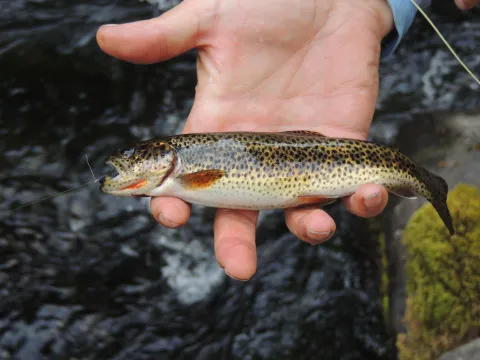
The estimation of a trophy trout is on a sliding scale. Since it does not take a lot of water to keep trout alive, trophy rainbows and cutthroat can be found in a lot of east-slope and west-slope creeks and rivers, and even a few north-slope trickles.
Highway 35 parallels and crosses the East Fork Hood River, which is home to beautiful cutthroats, vulnerable to any high-floating bushy dry fly.
Anyone good with a map can locate a dozen other small streams that can be accessed for spot-and-stalk dapping or casting in the same area.
In the Clackamas drainage, the Oak Grove Fork offers a bushwhacking opportunity where the light plays on the riffled water and mayflies dry their wings and form small clouds over the log jam pools.
Another stream winding down out of the national forest is the Breitenbush. Any trout from the Breitenbush is a trophy and may be too small to eat, but in time it will grow larger in memory. But don’t be deceived, there are some big trout in the little river too.
Another steep little river is the North Fork Santiam, with both wild and hatchery trout. In the fast riffled water, the trout are watching the surface for the mayflies, stoneflies, and caddis caught in the current.
Miles and miles of the McKenzie River are driftboat floatable and wet wadeable. In these years after the big fire, the river’s overstory (canopy) has opened, and there is no doubt the bug life has responded to the sunlight. Resident rainbows can grow big, coming out from under the cutbanks to feed.
Of the rivers and creeks tributary to the Willamette, the Middle Fork is a great option for the wading angler. In fact, there are a dozen streams. Pore over a map with a highlighter and note where the rivers cross under the roads. There will be a pullout and a trail down through the alders. An angler can base camp at Lowell, Westfir, or Oakridge and fish for days without going over the same water twice.
FLIES FOR SUMMER WADING
A well-stocked fly box should have foam body ants. It helps to tie or buy the fly with a high-viz wing to keep track of it in the riffles. Attractor dry flies like the Stimulator and its variants are great for those rare moments when the fish are feeding on stoneflies. Mayflies and caddis can be tied with a little foam or hollow-bodied deer hair. Another good attractor is anything from the Chubby series. Sometimes, when fishing a chubby, it’s a good idea to tie on a dry fly dropper. Cut off at least 20 inches of 5X. Put an ant on the light tippet tied off to the bend of the hook of the bigger fly. Then set the hook at a splash.
There are still a lot of places where rainbows and cutthroats flash to caddis from out of downed timber, the sun filtered through alders. The braided currents open windows to heaven in the clear water. Trout fishing is still like prayer.
To cast a dry fly and present it in a natural drift; to see trout come up out of the dark water to take it, that is the pinnacle of fly fishing.
# # #
For a copy of the Fishing Central Oregon book, send $30 to Gary Lewis Outdoors, PO Box 1364, Bend, OR 97709 To contact Gary Lewis, visit www.GaryLewisOutdoors.com


