
How to turn eggs from hatchery trout into more hatchery trout.
We had a mild, dry winter with little snowpack. Now in the heat of summer, wildfire smoke shrouds the lowland valleys, and a lot of people who would rather be fishing are staying home.
Up in the mountains, the air is clear and beautiful. If there is smoke in the air, it filters the light and provides an otherworldly feel on the high lakes.
Here in central Oregon, the trout fishing has been fantastic. Fly-rodders, lure fishermen, and bait anglers have been having the best trout season of their lives.
I have started tying egg loop knots and curing eggs on a smaller scale. Our hatchery programs turn out legals, "trophy" trout (14 to 18 inches), and brood stock fish that can go six pounds or more. Some of those hatchery fish have eggs in them, which look like bait to me.
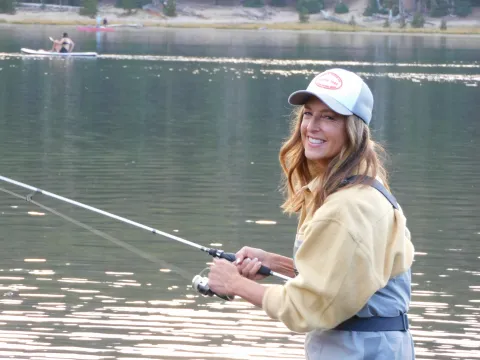
WHY SPAWN SACS?
Trout eggs are few and fragile, and the skein is weak, but they are a dynamite way to turn hatchery trout into more hatchery trout.
Use spawn netting to conserve the eggs for a longer time in front of the fish. While an egg-looped bait might stay on the hook for three or four casts, the spawn sac bait can go for 40 or 50 casts and multiple fish.
I kept the eggs from a 30-inch lake trout and put them in a paper towel in the refrigerator, and forgot about them till I was in Alaska. My wife was home and cured the eggs for me (her first time curing eggs), and we put them to use on a fall trip to one of my favorite lakes. I wound up catching a pair of beautiful brook trout. Opening our mixed bag of rainbows and brookies that evening, I harvested bait for the next trip.
Try to get eggs from four or five trout before starting the cure. First step in preparing the eggs is to allow them to air dry on a paper towel for a day or so.
The cure itself can be any one of dozens of commercial powder or liquid offerings or a person can prepare their own with Borax, brown sugar, and salt. Lately, we have been using Pro-Cure's Last Supper blend, augmenting it with sea salt and krill powder.
Donning latex gloves, I roll the eggs in the cure, making sure the cure adheres to both sides of the skein. Next, I sprinkle on extra salt and krill powder. Then I let that combination drain/air dry for about a day. After that, the eggs are ready for the spawn netting.
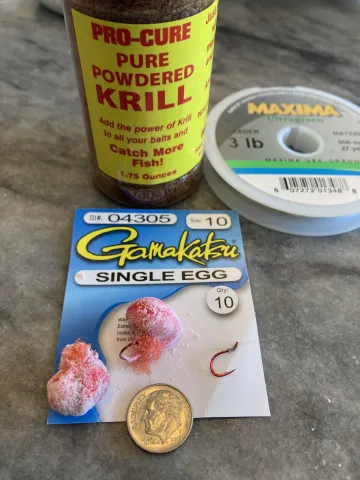
For these smaller baits, I will use a No. 8 or No. 10 egg hook with an egg-loop knot. The bait should be the size of a dime. I get two to four baits out of a skein and four to eight baits per fish.
Cut a small rectangle of netting (I use Atlas Mike's) and lay the bait on it. Then gather the edges and tie it with stretchy string (like Kwikfish Stretchy Thread. Trim off the extra string and netting, and you have a dime-sized bait ready to fish.
Baits can be stored in Ziploc bags, plastic boxes, or glass jars. Use the baits as-is or add a little more Borax to toughen them up.
Curing eggs for a spawn sac presentation allows the angler flexibility in doctoring the baits to specific conditions or to provoke a reaction bite. Eggs sink, which makes spawn sacs a great choice for a float (bobber) presentation. But because eggs sink, they are prone to hang up on rocks in a drift-fishing presentation. The "cure" for that is to add a foam egg (like a Mad River Fish Pill) to the spawn sac.
Jason Hambly, of Pro-Cure Bait Scents, in Salem, Ore., recommends adding krill powder to any trout bait. Garlic, too, is a proven trout favorite. I like to add a touch more garlic to a bait intended for cold water presentations. When the temperature drops in December in these parts, it can be harder to get fish to move. But they seem to move for garlic. Salt, brown sugar, and anise are other scents that could be added to spawn sacs. It makes a lot of sense to bring several flavors and experiment with what works in varying conditions.
STILL WATER RIGS
For our fisheries, I like a finesse presentation using a smaller No. 10 egg hook and a light three-pound test leader. When targeting bigger trout, consider sizing up to a No. 8 egg hook, nickel-size baits, and a five- or six-pound-test 20-inch leader.
Attaching bait is as simple as running the point of the hook beneath the netting knot, then securing it with the egg loop.
In a lake, the bait can be presented under a float when targeting a specific feeding zone. I like to use a sliding sinker fished over a ledge on a travel zone, such as along a drop-off.
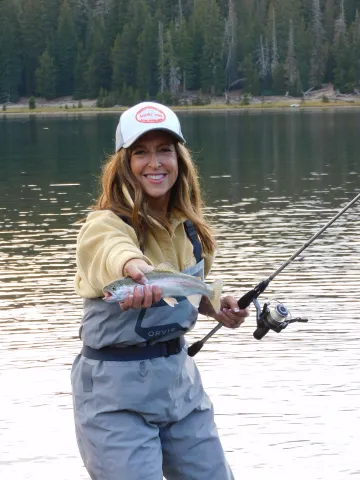
WHERE TO FISH
In August and September, plan trips to hit one or more fisheries. Think early morning and late evenings. Eat an early dinner and fish the last two hours of the day. Get up at dawn, fish for the first hour of the day, and then go get breakfast.
In the Cascades, top destinations include Diamond Lake, Detroit Lake (even as it draws down), Cultus, Elk Lake, Olallie Lake, and Timothy. But there are a hundred more. Open a map or get a copy of the Fishing Central Oregon book or Fishing Mt. Hood Country. The Department of Fish and Wildlife stocks all the drive-to and hike-in Cascade lakes.
Sometimes it's fun to experiment with something new, to do something different.
Reinvent your fishing and target trophy fish and brood stock with scaled-down baits.
# # #
Gary Lewis makes his home in Central Oregon.


