
Learn how to quickly read and tackle big fish in unfamiliar waters.
If an angler is hunting big fish on the Columbia, the challenge is to read the water fast. It’s a lot like how tournament anglers have to adjust when fishing a lake for the first time.
My biggest ever largemouth came from the mouth of the John Day River. We were done fishing for the day, but we wanted to throw a cast at a clump of willows. The big fish, a female, was staged right where she could ambush minnows running out of the mouth of the river. She ambushed the wrong thing that day. After we weighed her, we put her back.
The river is home to a few largemouth, but smallmouth bass are the primary target.
AN OPEN-MINDED APPROACH
Once, I interviewed a couple of bass pros about how they find big fish fast. Ish Monroe, an MLF pro from Hughson, California, said, "Most people miss out when they don't approach the water with an open mind."
Dean Rojas, from Lake Havasu, Arizona, pointed out that western reservoirs are characterized by lots of rock and clear water. That sums up the Columbia. Rocky points, rip rap, cliffs, and beaches illustrate where bass are likely to be in the summertime.
Sometimes we get hung up on what color of bait works best in what kind of water.
"In clear water, I use more natural colors," Ish said. "In dirty water, dark colors like black and blue or bright colors like chartreuse work better."
Shade is most important, Monroe said, "and thick cover." But the third component is access to deep water. "In shade and heavy cover, bass just sit in it and wait for the bait to come to them."
One of the best tools for the traveling bass angler is Google Earth. A quick virtual tour of a reservoir can reveal structures that might not be seen at full pool. Old photos can reveal structures that were flooded when the dam was built.
The McNary Dam, which holds Lake Wallula, was finished in 1954. The John Day Dam, which created Lake Umatilla, was completed in 1971. The Dalles Dam was completed in 1957, creating Lake Celilo. All three lakes flooded small ranches, small towns, small roads, and the mouths of creeks. Those roads and foundations are all still there, but are not evident except at extremely low water.
A better way to see the structure is with Navionics. The same water, examined with a Navionics chart, reveals the road beds, old foundations, and submerged bridges. Imagine bass bedding on the old road and schooled up in an old schoolhouse.
A few days before a trip, I like to check Weather Underground (www.wunderground.com) for the 10-day forecast. This site tracks cloud cover, temperature, precipitation, wind, wind direction, and the barometer. It is hard to quantify how barometric pressure affects bass fishing, but it does. When the barometric pressure is high, fish tend to be slow and sluggish. In general, I like to hit the water when the pressure has been stable, around 30.00 for three days, ahead of a low-pressure front. Fishing tends to be best when the pressure is dropping, is low, or slowly rising. When the pressure is higher, expect fish to pull back into cover or suspend in deeper water. In these cases, downsize the bait and try for pinpoint casting into heavy cover. Or use a slow spybait presentation in deeper water.
Sometimes the biggest fish come when stalking close to the bank. One time on the big river between Biggs and The Dalles, I was fishing with Jim Goerg and Michael Gibney. I was drowning a new swimbait, and Gibney and Goerg were using tubes. At the head of an island, Gibney stepped up to the trolling motor. “20 feet deep here.” Wham! My rod bent with a 12-inch bass.
Gibney’s rod shivered, and he set the hook. I brought my fish to the boat quickly, but there was no stopping Gibney’s fish. “I don’t know what this is, but it’s not a bass,” he said. “And it’s not a salmon.”
A six-foot, six-inch three-power Lamiglas and a Pflueger Maxx XT spinning reel loaded with 20-pound braided Power Pro is good medicine for a four-pound bass, but Gibney was definitely under-gunned for the mystery fish he’d hooked. We followed the fish into 70 feet of water, dangerously close to the nets.
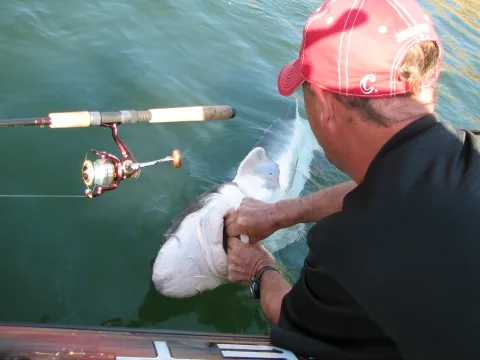
Twenty-five minutes later, we caught a glimpse of a seven-foot sturgeon, with a three-inch green pumpkin red flake tube in its mouth. Close to the boat, another huge sturgeon rolled. The fish blasted for deep water again, and Gibney handed me the rod.
Fifty-two minutes after the beast grabbed the tube, we had him alongside the boat, where I backed the hook out with pliers. He kicked away with a splash that drenched the bass pro.
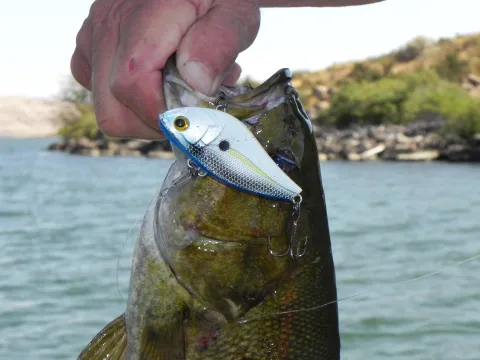
Gibney wiped the water from his glasses, and we went back to the head of the island. I switched to a tube. Gibney tied on a silver-sided jerk bait. He rocketed a cast past an underwater ridge of rock, and we watched, stunned, as two 6-pound smallmouths attacked. Gibney's bait was almost out of the water, but one of the 6-pounders grabbed my bait and spit it back out, then the other slammed it and threw the hook. A third fish, the consolation ten-incher coming out of nowhere, clamped down, held on, and coughed up a crawdad on the way in.
# # #
Gary Lewis makes his home in Central Oregon.
SIDEBAR
Prospecting the Back Bays
Bass often hide in surface weeds, which can grow a thick mat of vegetation at the surface.
Look for grass mats or weed mats with open water beneath them. This could be broken-off tule reeds, patches of lily pads, or dead weeds of any variety - anything that provides protection above and freedom of movement below. Anglers walking the shore can often do better than fishermen in boats.
Flip or pitch into vegetation. A lure with fast-sinking action causes reaction strikes. If the rig sinks and hits the bottom without a strike, try again close by. Use a heavier rod for punching because fish hooked in these close quarters can come with five pounds of weeds.
Get no closer to the shoreline or the weed bed than a long cast. Stay off the trolling motor. Stay quiet on the boat. Try not to open and close the rod lockers in shallow water.
-Gary Lewis


