
Far down in the southeastern corner of Washington State, there’s a river that is surrounded by millions of years of geological wonders. The journey begins at its headwaters in the Bitterroot Mountain Range of Northern Idaho. It meanders southwest and cuts through a landscape of grassy hills, formed by millions of years of wind-driven sediment that lay atop Pleistocene-era lava flows. For miles, it flows through a steep canyon carved out by the great Missoula flood that occurred during the rupture of an ice dam during our last glacial maximum. Finally, in Southeast Washington, it ends its solo journey at its confluence with the Snake River.
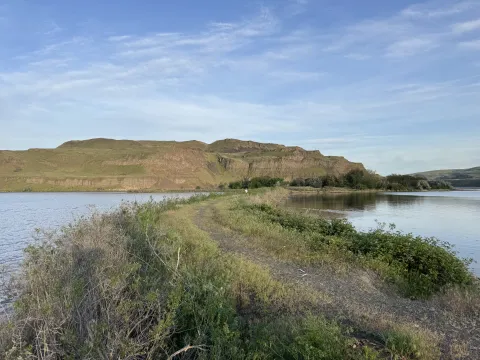
Historically, the waters at the confluence of the Snake and the Palouse were turbulent, characterized by rapids and fast-moving water. When Lewis and Clark reached the confluence of these two rivers during their expedition, they wrote about the ferocity of the water and how members of the group who didn’t know how to swim opted to go ashore and lug supplies on foot. Today, the waters here run much slower due to the construction of the Monumental Dam about 14 miles downstream on the Snake.
The slow-moving water near the confluence makes great habitat for a variety of fish like walleye, channel catfish, yellow perch, bluegill, smallmouth bass, and northern pikeminnow. What’s more, the fertile wheat land surrounding the Palouse offers a specific advantage for anglers targeting catfish. Peppered up and down the river are shoreline grain elevators where grain is transferred from barge to land, and during harvest season, these spots attract large numbers of Channel Catfish. Anglers can boat to these grain elevators and target fish that feed on grain spillover.
Catfish can also be targeted near shore in shallow, calm flats and deep holes with rocky bottoms. Channel catfish can be caught with night crawlers, bread dough balls, chicken livers, crawfish, shrimp, and stink baits, but the most consistent bait for me remains cut fish. Typically, a 1-2 inch chunk of yellow perch will do the trick.
Another method to deploy during the channel catfish spawning season (late spring-early summer) is running a small jig past a male catfish who sits guard over a nest. This often triggers a defensive strike from the male. This is a sight-fishing type of method, so to be successful, you’ll want a decent pair of polarized sunglasses and will need to be accurate with your casting.
Fishing the Palouse after June 16th in Washington State means 2 pole fishing is permitted. Since fishing for Channel catfish can often be a long waiting game, the two-pole endorsement offers up a great opportunity for rigging one rod up for the more passive catfishing while then using a second rod for something more active, like casting swim baits for walleye or smallmouth. It's good to equip your catfish rod with a bell at the tip to indicate a strike that you may not have noticed otherwise.
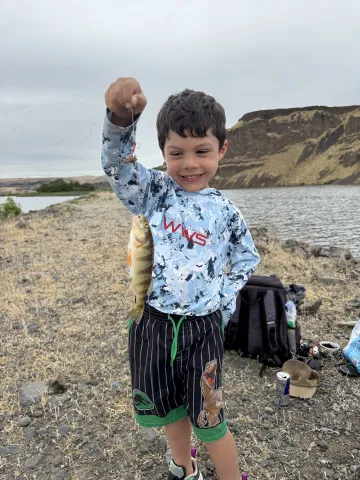
If you’re interested in catching a variety of fish and don’t want to deal with the hassle of switching from one setup to another, no need to worry; there is a simple solution. A nightcrawler, a hook, and a worm tied together on a simple drop rig is a setup that I use for shore fishing on the Palouse, and I have caught walleye, panfish, pike minnow, and large catfish on it. It's a one-size-fits-all set-up and works wonders in the calm waters of the Palouse. It’s also a great setup for kids, so long as they have the patience to sit and wait for a bite.
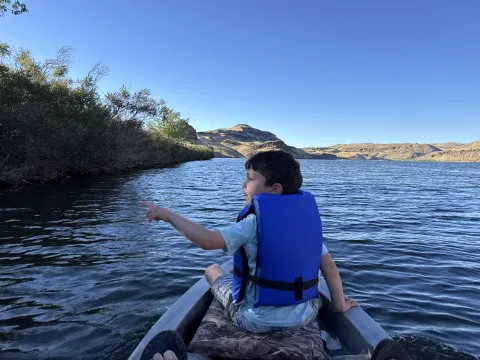
I’ve seen some pretty nasty winds at the Palouse, and each time I’ve been pleasantly surprised by the lack of effect the wind had on the water. This could be because of a sheltering effect from the canyon walls surrounding the water, the lack of depth in the river itself, or a combination of both. Either way, the lower Palouse is a safe and excellent spot to launch a kayak or any other type of boat for a day of fishing.
There are multiple boat launches on or near the lower Palouse. Lyons Ferry State Park offers a boat ramp and shore fishing opportunities. Riparia boat ramp on the Snake River is just east of the confluence of the Snake and the Palouse. Ayer Boat Basin is on the Snake River and about 7 miles west of the confluence. It has two boat ramps, a large parking lot to accommodate vehicles and trailers, and a campground for visitors,
So, if you’re looking to get out and explore some of the most beautiful and geologically rich lands that our state has to offer, and you wouldn’t mind coming home with a cooler full of a variety of fish, then the Palouse is where you should be heading on your next trip!


