
After moving to Great Falls, Montana, I’ve been spending much of my time exploring the various fisheries in my new State. The past year, my focus shifted to one of my favorite fish to eat, good old “marble eyes”, AKA walleye. It turns out that Montana isn’t just a trout state. The more I learned about Montana walleye, the more excited I became. While a walleye is a walleye and state borders don’t change that, I have noticed a few differences between fishing for walleye in Montana as compared to Washington.
I have many fond memories of fishing the Potholes, Banks Lake, and the Columbia River. All are beautiful destinations and hold healthy walleye populations. Over the years, I learned a lot about walleyes from Shelby Ross of Ross Outdoor Adventures. So, when I began exploring walleye fishing in Montana, I felt I had a pretty good idea of what I was doing. How pride goes before the fall!
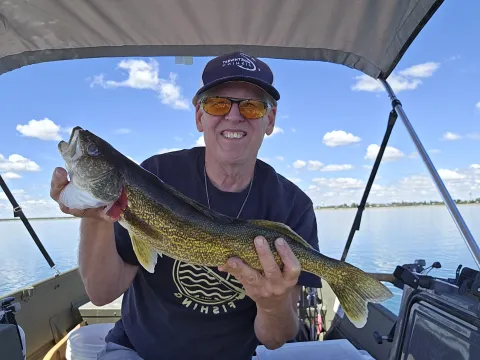
Walleye in Montana are… different. Underwater structure is different as well. While the Potholes in Washington features long stretches of submerged dunes that are made for trolling, reservoirs in Montana tend to be more vertical, with structures rapidly dropping off from shallow to deep water, and fewer long flats are present. And when you do find a flat area, it’s easier to find yourself dropping off from shallow to deep in a matter of seconds. Likewise, the Columbia River is significantly different from the Missouri River. Big, deep water vs. shallow water with distinct holes distinguishes the two rivers entirely different to approach and fish.
I’d read that the Missouri River was a challenge to unlock, and I found out just how true that was. One section below the Hauser Dam is prime trout water, with riffles, pockets, and runs that would make a line-flinger light up. And yet, walleye can be found in this very stretch of water, just waiting for someone to toss a plug their way. Go downriver farther to my neck of the woods, Cascade to Great Falls, and you’ll find deep holes of 15-20 feet and then stretches of sand bars waiting to trap an unsuspecting prop boater (best to have a jet boat in these waters). Farther down, as you reach Fort Benton and Loma and the river, free of dams until Fort Peck, reminds me of the Cowlitz River with fast runs, distinct tail-outs, and gorgeous pockets that just dry out “fish me!”
In other words, a walleye angler fishing the Missouri will need to be flexible with a number of different techniques. Bottom bouncing, jigs under floats, jigs with no floats, plugs, spinners, bait, no bait – whew! I’m going to need a bigger tackle box.
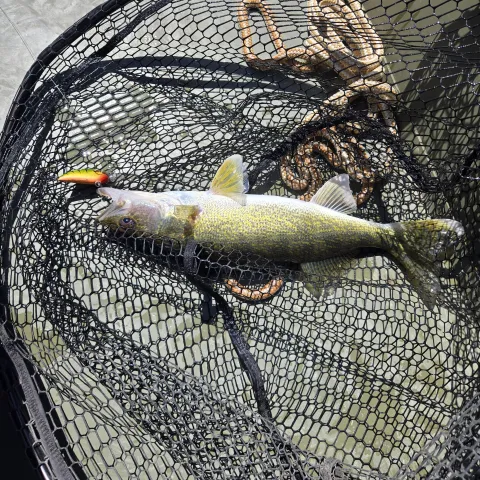
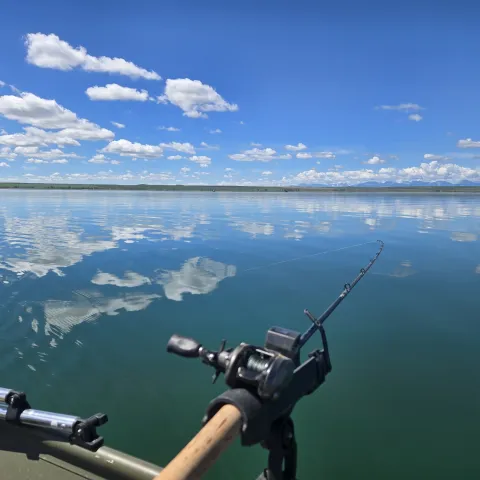
Meanwhile, in Montana, when we talk about lake fishing, we are often really talking reservoirs. A whole new set of challenges to learn. Yes, you can find nice flats to troll your bottom bouncers and diving plugs, but be ready for sudden and dramatic depth changes. These bodies of water have covered up river valleys and can reach depths of 120-200 feet in short order. In addition, you’ll find some very juicy bottom structure, underwater rocky humps that you’ll want to mark and come back to in your walleye search. Jig fishing these drops and humps is your best option here. Put away the trolling and use that spot lock anchor button and work these promising underwater drop-offs with a jig. Try tipping your jig with a minnow or a leech to entice even the stubbornest of walleyes.
Something else I have noticed that is quite different between Washington and Montana walleye is growth characteristics. While Potholes and the Columbia are generally a numbers game, in Montana, my experience has been that quality and not quantity has been the norm. I can confidently say that every location I’ve fished for walleye has yielded not a limit of eaters, but rather, I tend to catch a couple of eaters and then a pig, 22-26”, fat, quality fish. Why this is so, I can’t say. Maybe less pressure and more feed allow for greater growth and more quality fish? Maybe pike keep the small fish in check? A recent trip I took to Nelson Reservoir yielded a dozen pike in the 28-33” range, and only four walleyes, one of which was a beautiful 23” specimen. Those pike must be feeding on something to produce so many big fish…
Montana has a healthy walleye fisheries program, and the hatchery at Fort Peck took 62 million eggs last year, enough to stock the needs of the entire state’s walleye fisheries. In addition, Montana Fish, Wildlife, and Parks (FWP) has introduced cisco, a herring-like forage fish for walleyes, into Fort Peck and Tiber reservoirs, resulting in an eye-popping winning weight of 143 pounds in the 2025 fishing derby at Tiber Reservoir.
What isn't different between Washington and Montana walleye is the taste. Anglers can enjoy delicious fresh walleye year-round, either in open water or in the winter through the ice. Unfortunately, both states also share a common problem: contaminated waters. I strongly urge you to follow guidelines on fish consumption and limit the fish you keep to under 22". Doing so will reduce your risk of contamination from mercury and Per- and Polyfluoroalkyl Substances.
Stay safe and enjoy the incredible walleye fisheries each state has to offer!


