
Winter Steelhead fishing in Washington has long been a passion for serious anglers. After all, fishing in inclement weather for a species that is hard to catch is not for the lighthearted. It takes serious motivation to pursue these fish, and for those who understand, it often becomes an obsession. With the winter steelhead season almost upon us, historically, Thanksgiving usually marks the beginning of the winter run on the Washington Coast, with opportunities inland that last deep into the spring. My rule of thumb is to start on the coast during the late fall, early winter, and move inland to the Puget Sound and SW Washington rivers in March and April.
I have many friends today who grew up steelhead fishing. Many of them are older than me and remember the days when there were lots of fish and the fish were big. Danny Cook from Wooldridge Boats told me a story of hooking a wild steelhead just below the Sultan launch on the Skykomish that tipped the scales at over 30 pounds. This was during a time when you could kill wild fish. Danny is a legend among steelheaders and has caught no less than five steelhead over 30 pounds, but the likelihood of repeating that today is not very good.
I will never forget my first steelhead trip. It was the late 1970s, and my dad decided that we were going to try fishing the Skagit River for steelhead. You see, he had a coworker who was obsessed and was willing to give my dad some tips. As a result, we planned a trip and set a date. The gear that we used was very primitive. We cut out the plastic lid of a coffee can to act as a spreader, to which we punched three holes and attached paper clips. I still have one of these today. To one paper clip, we connected the mainline. To another, we connected a short dropper to a pyramid weight. To the final paperclip, we attached a leader with a large spin-n-glo and a gob of eggs that my dad’s coworker gave to him.
We set out early on a Saturday morning with the intent to plunk a piece of private property on the Skagit. We set up camp chairs, cast out our gear, and sat down to wait for a passing fish to take our setup. It seemed like forever, but then again, I was about eight years old. When a bite finally came, it was my rod that went off. My dad yelled, and I jumped out of my camp chair to grab my rod. Once I had control of the rod, the line started to peel off the reel, and the fish was pulling me down the riverbank. Eventually, the fish found some wood and got me tangled. That was the end of my first steelhead encounter, but I will never forget it. What stood out most was the power of that fish. Unfortunately, that was the first and last time that we targeted steelhead until I became an adult, and it was the only time that I steelhead fished with my dad.
So, what has changed, and why is steelhead fishing today a shell of what it once was? The answer is simple: almost everything has changed. We don’t need to get too deep into the issues steelhead face, but let’s just say that the deck is stacked against them. To me, the greatest challenge has been fish politics. We once had robust hatchery programs that helped to sustain the populations, but most of those are now gone due to wild fish advocacy. There are still some hatchery programs, such as the Cowlitz, that offer prolific opportunities to catch and keep steelhead, both winter and summer runs. Also, the hatchery programs on the Quinault and Queets Rivers on the Olympic Peninsula offer some of the best steelhead fishing opportunities that exist today. Outside of the limited systems that have active hatchery programs, it has become a guessing game from one year to the next as to whether we will have opportunities for catch and release of wild steelhead. There may be opportunities on Washington’s coastal rivers, to the inland rivers of the Puget Sound and SW Washington, and even the interior rivers that feed the mighty Columbia.
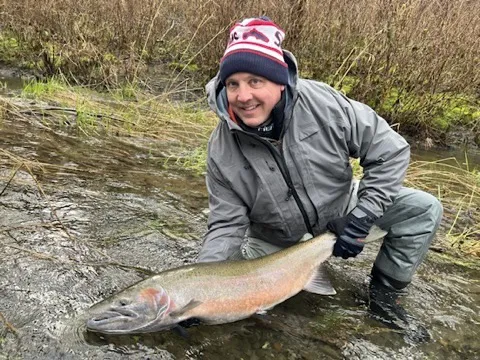
The good news right now is that it seems that steelhead are faring a bit better in some areas with better returns. It is a far cry from the numbers that we saw return during the period from the early 1970s to the early 2000s, but things are looking up a bit. Politics are still playing a key role in creating obstacles for steelhead, and that will not likely change, but current ocean conditions have been favorable, and the resulting returns have been up in some areas over the past few years.
When we evaluate our salmon and steelhead returns, we measure the returning fish according to a forecast and a 10-year average. For the most part, sockeye, pink, and coho salmon runs have been improving. Chum salmon runs are improving in some areas, but are still threatened. Chinook returns continue to struggle for more reasons than I wish to share, but for some reason, this species faces the most pressure of the five species of salmon. Steelhead, both winter runs and even more so for summer runs, are in a similar situation as chinook, with continuous decline. In my opinion, mirroring the broodstock programs employed on the Oregon Coast could help our steelhead populations since so many hatchery programs have been sued into submission and shut down. This alone could make a huge impact on the process of restoring our returns. Another option, an option that anglers don’t want to hear, is that we shut down river systems that are facing critical issues. This is not popular, but look at the Sauk River as an example. It was shut down for many years to recreational fishing, and the population recovered on its own to the point that we now see a somewhat consistent opportunity for catch and release. As far as 2026, that remains to be determined.
Either way, for those of us who love to chase steelhead, whether it be winter or summer runs, we will find opportunities, and we will travel wherever we need to go. For those new to the sport or considering becoming a steelheader, here are some tips and some information that I would like to share. To start, keep in mind that steelhead are more elusive than our migrating salmon runs and less predictable, making them more difficult to catch. Changes in river conditions during the wet, winter months are constant, forcing us to drop what we are doing and go when the conditions are best. We also need to change up our techniques based on river conditions. Scheduling a trip in advance can often result in disappointment when the river blows out or it gets cold, and the river drops to very low and clear conditions. This is steelhead fishing, so you must get used to it.
Most of my Steelhead fishing has been done in the rivers in from Everett north, the Chehalis Basin, the Cowlitz, and the Washington Coast, specifically the Forks area and the Quinault and Queets Rivers, within the reservation as well as Olympic National Park. There are still many options available all the way to the east in Idaho on the Snake and Clearwater rivers, so I recommend that you start with a river that interests you and is open for either retention of hatchery steelhead or catch and release of wild fish. Check the regulations for opportunities and, most importantly, some good guides who know the river well. I encourage you to spend the money to fish with a guide to learn what works and understand how to target fish in different conditions. Time is money, and the learning curve to catching these fish can be steep, so reduce the curve and spend a few days with a guide so that you can learn and then go practice what you learn on your own. Know that every guide has a different opinion and approach, so I recommend that you try a few to gain a broader perspective.
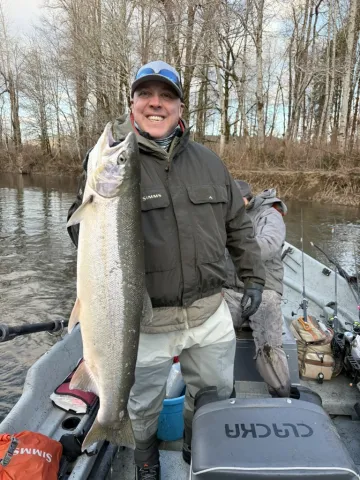
If you are new to steelhead fishing, I recommend that you NOT go out and buy all your gear before you learn the basics. You can spend a lot of money only to find out that you didn’t need a lot of what you bought. Mirror what your guide uses, as their methods are tried and true. Watch YouTube and pay attention to fishing shows such as Northwest Fishing. You will learn a ton that will help reduce the learning curve and get you into opportunities. To start out, I do recommend that you purchase a nice pair of waders and wading boots and a jacket that is waterproof. Getting cold and wet will ruin your day in a hurry.
There are many popular techniques for catching Steelhead, such as casting or trolling plugs from the bank or shore, throwing spoons and spinners, float fishing beads, bait, jigs, and other offerings, drift fishing or bobber dogging beads, yarnies, bait, and other offerings, and much more. So many different options to choose from, and they all work. Again, keep it simple and choose 2-3 methods that you are taught, such as bobber dogging beads, float fishing jigs, and casting spinners and spoons. Many guides only use a few methods and do very well.
Now, you have learned the basics from one or more guides, you have learned how to fish a specific river system, you have purchased a handful of the gear that you need, and the time has come to go out and give it a shot. Believe me, you don’t have to go buy a drift boat to fish. There are plenty of opportunities to wade and bank fish. Also, I encourage you to continue to fish with guides if you want to boat fish or make a friend who has one. Believe it or not, many fishermen who own boats are looking for fishing buddies, so join a Facebook group to make some friends.
Also, I will emphasize again that time is money. Some of us have more time and others more money, but either way, our days on the water are limited, so it is my opinion that we should make the most of them. Pay $200-300 to fish with a guide and let them do the work. Also, they spend every day on the water, so they know where the fish will be and how to catch them. You can easily make 10-20 trips without a bite on your own if you don’t know what you are doing. With a guide, that learning curve might be eliminated, and you may catch a fish on your first trip. I can promise you this: you will never forget a steelhead that you catch. The encounters are memorable and, to me, unlike any other species encounter.
Steelhead fishing is an amazing pastime, and until you have spent some time doing it, you really don’t realize how special it is. I can say that they are very special fish, and you will never forget your first or for that matter, any Steelhead that you catch.
You can contact me on Facebook if you need additional tips or want to be connected to a guide near you. I am always happy to help and more than anything, I want you to learn and to have fun


